
ACETATE EYEWEAR MANUFACTURING · PART 2 OF 9
Acetate sheet layout and cutting determine where frame fronts and temples are taken from a sheet, how directional patterns appear, and what material remains for later machining. The aim is to balance the approved appearance, material use and processing requirements—not simply fit the most parts onto a sheet.
In part one, on acetate sheet quality and frame durability, we examined whether a material is suitable for a frame design. This article takes the next step: deciding how that material will be used before detailed machining begins.
What do layout and cutting mean in acetate eyewear manufacturing?
Layout means arranging the position and orientation of components on an acetate sheet. Cutting means dividing that sheet into blanks suitable for the next production stages.
A cutting blank is not a finished frame. Detailed cutting, forming, grinding, polishing and assembly still follow. Cubitts, for example, describes precision CNC machining of fronts and temples from acetate sections using CAD designs; its account is a useful illustration of this distinction, not a specification for every factory. Reference: Cubitts Framecraft.
At the layout stage, the useful questions are whether the selected area will give the intended appearance, whether fronts and temples will look coordinated, and whether enough material remains for the planned processing method.
Why should acetate pattern direction be agreed before cutting?
Solid colours and directional stripes, gradients or laminated effects need different visual checks. Rotating a component on directional material can change how the pattern runs across the frame. With layered material, the section also matters: which layers should remain visible after shaping?
Mazzucchelli recommends deciding the cutting direction before processing directional patterns, and evaluating sheets both in plan and in section so that machining does not remove layers needed for the intended appearance. Reference: Mazzucchelli materials and processing.
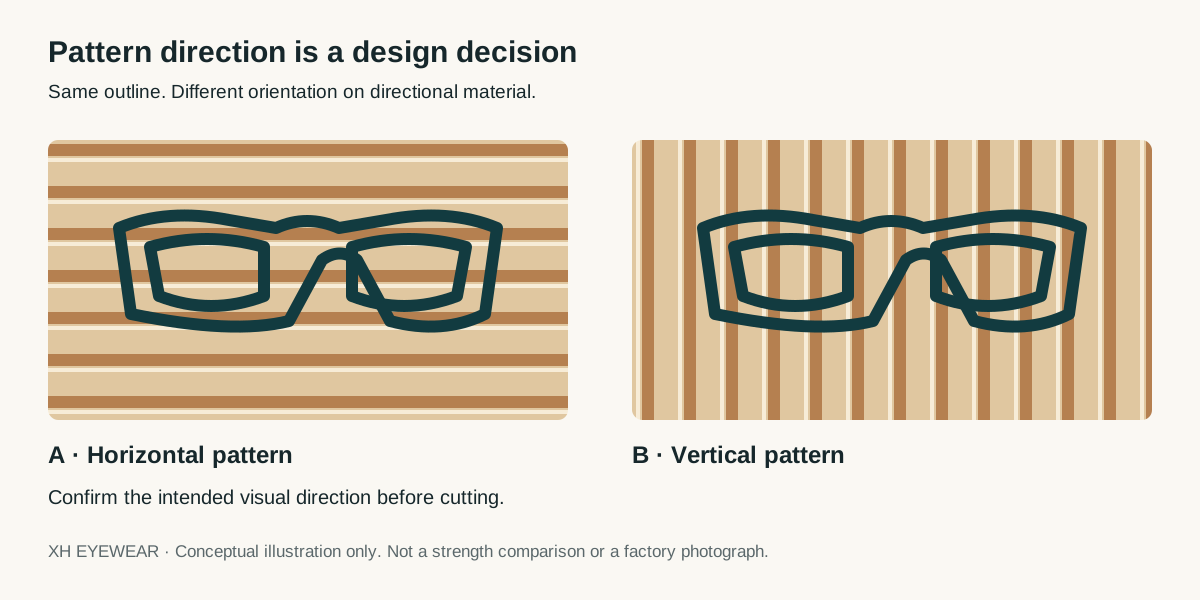
For sample approval, replace “make it like the colour chart” with a more precise visual instruction:
- The front should show a horizontal pattern.
- The inner colour layer should remain visible from the side.
- The two temples should have a similar overall lightness.
These are appearance requirements to assess with the selected material. They do not mean that a particular visual orientation is automatically stronger.
Why can frames made from the same acetate colour code look different?
A material code identifies a reference; it does not fix every mark on every component. In randomly patterned acetate, different areas can contain different light and dark regions. MOSCOT illustrates frame fronts being cut from larger tortoise-pattern sheets. Reference: MOSCOT on tortoise acetate.
For buyers, it is useful to separate two requests:
- Consistent overall character: an agreed base colour, transparency, pattern scale and balance of light and dark areas.
- Identical pattern placement: a particular dark patch in a fixed position, or strict left-to-right symmetry.
The second request needs a specific feasibility review; it should not be assumed from colour-code approval alone. Instead of keeping only one particularly attractive sample photograph, agree a practical range of acceptable appearance. Record which differences are acceptable and which would require review.
Why is a cutting blank larger than the finished frame outline?
A blank must suit the next operation. Its size should account for the component outline, holding method, tool access and the material needed for later refinement. Machining allowance is material reserved for processing; it is not permission for the finished dimensions to vary.
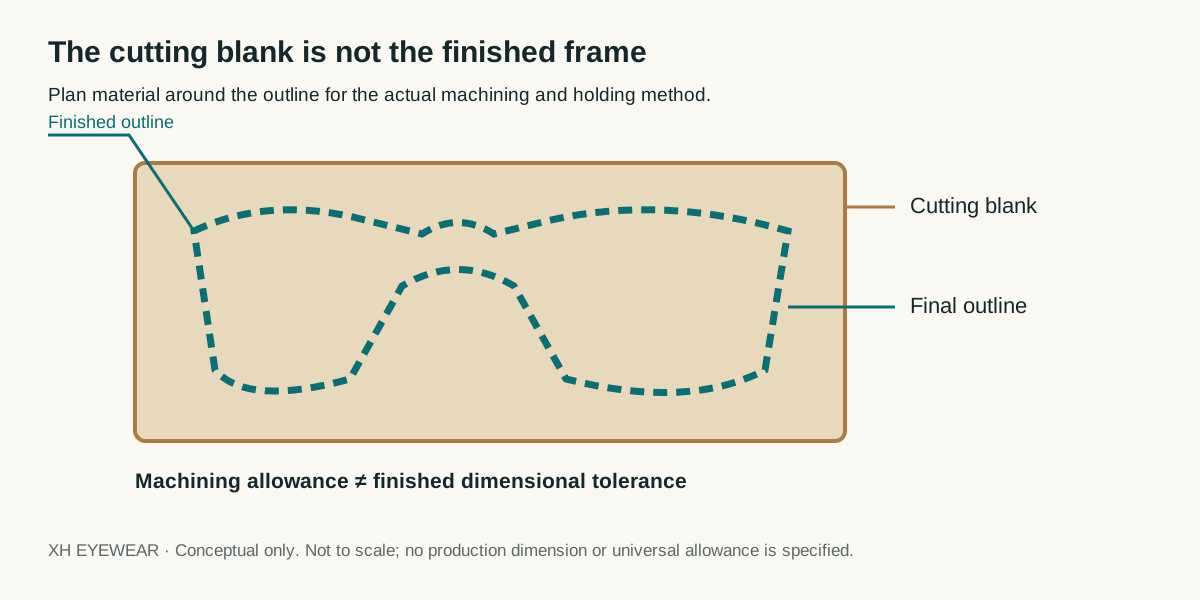
As a planning consideration, too little spare material can restrict holding or refinement; unnecessarily large blanks increase the material that must be removed. The actual allowance has to be determined for the drawing and processing route, rather than copied as a universal number.
Buyers should distinguish the starting sheet thickness, the finished thickness at important locations, and the final dimensional requirements. These are different specifications.
What should a buyer confirm before acetate frame sampling?
A short approval record is more useful than a long list of vague expectations. We suggest recording:
- Material identity: supplier or material reference, colour code and a sample—not only a description such as “brown tortoise”.
- Direction: any required stripe, gradient or visible-layer orientation.
- Acceptable variation: the permitted differences in pattern and lightness across fronts and temples.
- Approval references: which physical samples, photographs and annotated drawings will be used for comparison.
- Change control: which material or appearance changes require renewed approval.
This checklist is a proposed communication aid, not a claim that every design can meet identical visual requirements. A colour chart helps shortlist materials, but a finished sample is still needed to assess the chosen location, outline and three-dimensional appearance together.
Frequently asked questions
Does the same acetate colour code guarantee an identical pattern on every frame?
No. A colour code alone does not guarantee identical pattern placement. For randomly patterned material, agree the overall appearance and acceptable variation; fixed placement or strict symmetry requires a separate feasibility review.
Does a higher material yield always mean better frame manufacturing?
No. Compare material use only after the agreed appearance and processing requirements are met. The number of components arranged on one sheet is not a complete measure of manufacturing quality.
Are the finished frame dimensions determined at the layout stage?
Not completely. Layout and cutting prepare the material for subsequent work. Final dimensions still depend on controlled machining, forming, adjustment and inspection.
From suitable material to a workable frame blank
Part one asks whether the sheet is suitable for the frame. Part two asks how to use it for the chosen design. Clear layout requirements and practical sample references connect those two decisions.
Next in the series: CNC cutting and forming. Part three will explain what machines can control and what still depends on later processing. It has not yet been published.